Solutions
Household budgeting
Household budgeting is the practice of planning and tracking a home's combined income, bills, and savings as one shared budget. In Nethaven, two partners join a single household, link their own accounts, and see spending against plan together, each with their own login, not a shared password.
One budget, two incomes, separate logins
Most couples don't fail at budgeting because they lack a spreadsheet, they fail because the spreadsheet lives on one person's laptop and only one of them ever opens it. Nethaven turns the household into a shared organization: each partner signs in with their own credentials, links their own bank and credit accounts, and contributes to the same budget categories and limits. You see the combined picture, rent, groceries, childcare, subscriptions, rolling up across both incomes in real time, instead of reconciling two separate views at the end of the month. Because the data syncs from the same connected accounts that power net worth, debt, and goals, the household budget stays current without anyone re-keying transactions by hand.
Split the work, not the visibility
Shared money usually means one person becomes the unpaid bookkeeper. Nethaven removes that bottleneck: either partner can categorize a transaction, set a spending limit, or check progress on the grocery category from their own phone. Transaction rules auto-label recurring merchants once, so the weekly review is a quick pass over a short queue rather than an hour of data entry. When a category is close to its limit, both partners see it, so the conversation happens before the overspend, not after the statement arrives. The result is fewer money arguments rooted in surprise, because the surprise is gone.
Beyond the monthly budget
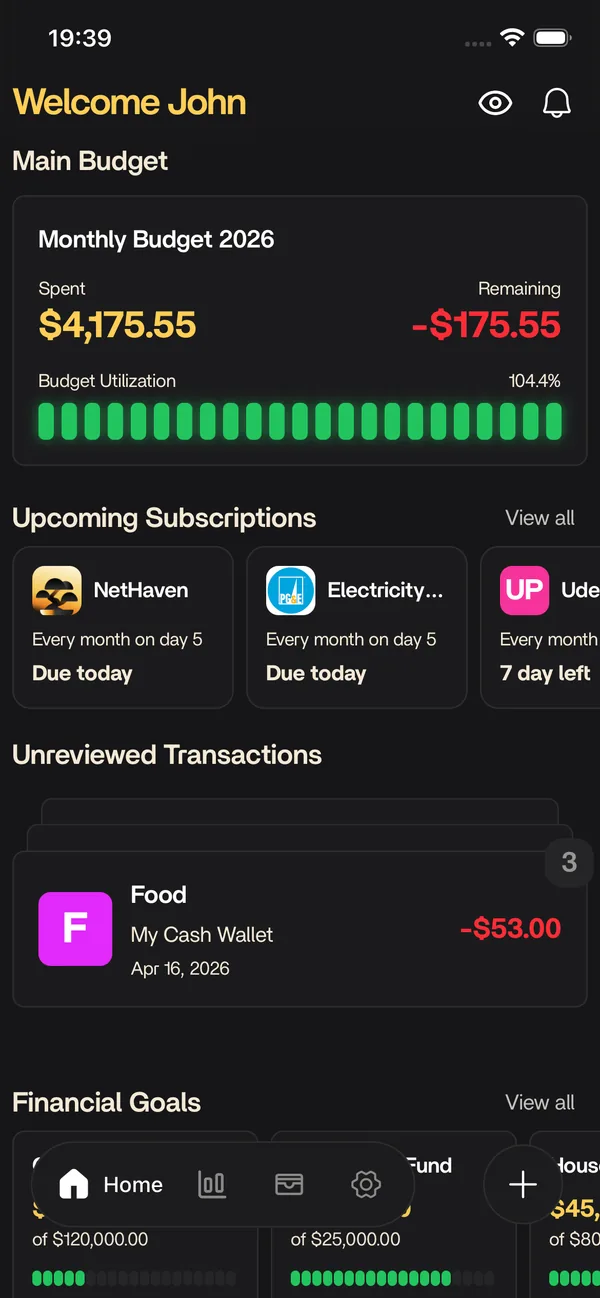
A household budget is only useful if it connects to the bigger picture. In Nethaven, the same dashboard that tracks this month's spending also tracks the family's net worth, debt payoff, and shared savings goals, an emergency fund, a house deposit, a holiday. You can see how staying under budget this month moves the savings goal forward, because goals are funded from real cash flow rather than wishful estimates. That continuity is what separates a budget that survives past January from one that gets abandoned: every category does double duty as both a spending guardrail and a contribution toward what the household is actually saving for.
How a shared household budget works in Nethaven
| Step | What each partner does | What the household sees |
|---|---|---|
| 1. Join the household | Sign in with your own login, accept the household invite | Both partners in one organization, separate credentials |
| 2. Link accounts | Connect your own bank and credit accounts | Combined balances across both incomes |
| 3. Set categories & limits | Agree on budget categories and monthly limits | One shared plan, not two spreadsheets |
| 4. Review together | Categorize transactions; rules auto-label recurring merchants | Live spending vs. budget, visible to both |
| 5. Fund goals | Direct leftover cash flow to shared savings goals | Net worth and goals updating from the same data |
Related features & tools
Budgeting
A flexible budgeting app with category limits, review-first transaction workflows, and a clear plan for narrow merchant rules when they launch.
Accounts
Connect US checking, savings, credit, and loan accounts through Plaid, or add a manual account. Balances and transactions feed your budget and net worth.
50/30/20 Budget Calculator
Split your take-home pay into needs, wants, and savings with the 50/30/20 rule. Free budget calculator - automate it in Nethaven.
Savings Goal Calculator
Find how much to save each month to hit your goal by a target date, with interest. Free savings goal calculator - track progress in Nethaven.
FAQ
Questions before you start
Free to download
Make Nethaven work for you
Set it up for your household, your side income, or your portfolio, then run it from iOS, Android, or the browser.
Not financial, tax, or investment advice. Data sync depends on institution availability; see in-app connection flows for brokerages supported in your region.