Alternative
A Zerosum alternative for 2026
Updated October 11, 2026
Zerosum is a zero-based budgeting app with an iPhone app, an installable web app, and plans from $30 to $75 a year. Nethaven is a Zerosum alternative for people who want budgets beside their investments: native apps on iOS, Web & Android, brokerage holdings, crypto wallet import, a dividend calendar, and receipt scanning. Zerosum is cheaper and already syncs banks.
How Nethaven compares to Zerosum
Same as Zerosum
- Category budgets, savings goals, and loan tracking
- A shared budget with a separate login per person
- CSV transaction import and a net worth view
What is different
- Native Android app, where Zerosum uses an installable web app
- Brokerage holdings and crypto wallets, not one tracked balance
- Receipt scanning, a subscription manager, and a dividend calendar
- Flexible budgets instead of a strict zero-based method
Not there yet
- Automatic bank sync, which Zerosum has on Plus and Pro
- Transaction rules, which Zerosum has for payees and imports
- A matching price: Zerosum costs to a year
Nethaven vs Zerosum at a glance
Nethaven | Zerosum | |
|---|---|---|
| Zero-based budgeting method | Flexible budgets | Included |
| Native Android app | Included, Nethaven advantage | Installable web app |
| Investment tracking | Brokerage holdings (SnapTrade), Nethaven advantage | Balance in a tracking account |
| Multi-platform | iOS, Web & Android | iPhone, Web & installable PWA |
| Subscription manager | Included | Recurring transactions |
| Highly customizable app | Included | Included |
| Broker integration | Varies (SnapTrade) | No direct integration documented |
| Dividend calendar | Ex-dividend and payment dates, Nethaven advantage | Not documented |
| Dividend date notices | Ex-dividend and payment date notices, Nethaven advantage | Not documented |
| Bank integration | Coming soon | Plus (your own provider) / Pro (Plaid, Lunch Flow) |
| Receipt & screenshot transaction import | Included, Nethaven advantage | Not included |
| CSV transaction import | Included | CSV, OFX, QFX & QIF |
| Budgets | Included | Zero-based method |
| Monthly surplus workflow | Carry into next month, allocate to savings, or keep unassigned, Nethaven advantage | Automatic category carryover |
| Debt & savings tracker | Included | Included |
| Crypto wallet import | Included | Not documented |
| Transaction rules | Coming soon | Import & payee rules |
| Smart integration (adapts to you) | Included | Payee learning & auto-fill |
| Net worth dashboard | Included | Included |
| Shared budgets | Included | 1 Basic / 3 Plus / 5 Pro members |
| AI chat | Coming soon | Not documented |
| Pricing | $9.99/mo or $99.99/yr | $30/yr Basic / $50/yr Plus / $75/yr Pro |
See the full breakdown: Nethaven vs Zerosum · Best net worth apps
Start with Nethaven in 3 steps
- 1
Download Nethaven
Get the app on iOS or Android, or open the web app, and create your account.
- 2
Bring your history
Import a transactions CSV, or scan a receipt or bank screenshot to add recent spending.
- 3
Set budgets and assets
Create budget categories, then connect a brokerage, import a crypto wallet, or add a home or car by hand.
Free to download
Make the switch in minutes
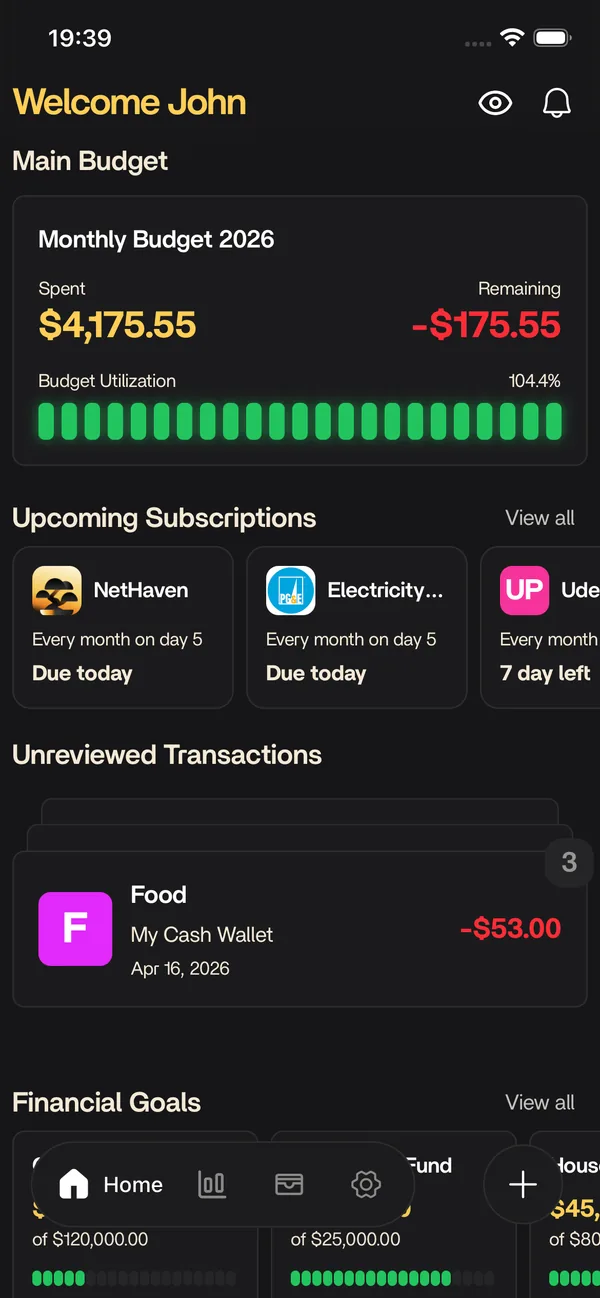
Use Nethaven on iOS, Android, or web to set up budgets, decide where monthly surplus goes, and track net worth, crypto, brokerages, and upcoming dividend dates. Bank integration and transaction rules are coming soon.
Why do people look for a Zerosum alternative?
Zerosum does one job on purpose. Its builder, Pedro Fidalgo, started it in mid-2025 after six years on another zero-based app whose price kept rising, and opened the public beta in February 2026. The result is a focused, low-cost budget where every dollar gets a job. People usually look elsewhere for one of four reasons. First, Android: Zerosum's install guide says there is no Android app yet, so Android phones use an installable web app that shows an offline screen without a connection. Second, investments: brokerage, retirement, and property values live in tracking accounts that hold a balance, not individual holdings, and crypto is not covered in the product or help pages. Third, the method: zero-based budgeting asks you to assign all of your money and keep reassigning it, which is more upkeep than some people want. Fourth, scope: there are no documented tools for dividends, receipt scanning, or subscription tracking beyond recurring transactions. None of these are flaws in a budgeting app. They are the edges of one.
What does Nethaven do that Zerosum does not?
Nethaven treats what you own as part of the same picture as what you spend. Supported brokerages connect through SnapTrade and bring in actual positions, crypto wallets import read-only, and property or vehicles sit beside them as manual assets, so net worth is built from holdings instead of one balance you update by hand. A dividend calendar shows ex-dividend and payment dates and can notify you of both. On the spending side, you can create transactions by scanning a receipt or a bank screenshot, import history from CSV, and track recurring charges in a subscription manager. Budgets are flexible category budgets, and at the end of each month a surplus workflow lets you carry leftover money forward, move it to savings, or leave it unassigned. All of it runs natively on iOS, Web & Android, so an Android phone gets a real app, not a browser install. Households join one organization with separate logins.
What does Zerosum do better than Nethaven?
Several things, and they matter. Zerosum already syncs banks: Pro uses Plaid in the US and Canada and Lunch Flow elsewhere, Plus connects through your own SimpleFIN or Lunch Flow account, and linked accounts refresh up to four times a day. Nethaven does not have bank sync yet; it is on the roadmap, along with transaction rules. Zerosum is also a true zero-based system with a Ready to Budget pool, payee and import rules, and the option to set income aside for next month. It imports full budgets from YNAB and Actual Budget, reads CSV, OFX, QFX, and QIF files, and ships 16 built-in reports plus custom dashboards built from more than 20 widgets. Keyboard shortcuts, undo and redo, and 17 color themes round it out. And it costs less than Nethaven on every plan. If bank sync, a strict zero-based method, and the lowest price are your top three needs, Zerosum is the better choice today.
How do Zerosum and Nethaven prices compare?
Zerosum has three annual plans. Basic is $30 a year for manual budgeting with one shared member. Plus is $50 a year and adds bank sync through your own SimpleFIN or Lunch Flow account, with up to three members. Pro is $75 a year with managed bank sync and up to five members. There is no free tier; the trial is one month of Pro and asks for a payment method up front. Nethaven Pro is $9.99 a month or $99.99 a year in the US, with a free trial where available and no limited free tier. That makes Nethaven the more expensive app, and for budgeting alone the extra cost is hard to justify. The price makes sense when the same subscription replaces other tools you would otherwise run next to a budget: a portfolio tracker for brokerage holdings, a crypto tracker, a dividend calendar, and a subscription tracker. Add up what you would actually use before choosing on price alone.
Which app fits your situation?
If your partner is on Android, Nethaven gives both of you a native app, while Zerosum gives the Android phone a web app that needs a connection to open your budget. If you hold stocks, ETFs, or crypto and want those positions inside your net worth, Nethaven imports them; in Zerosum you would keep a tracking account and update its balance. If you live in the US or Canada and want transactions to arrive on their own inside a strict zero-based budget, Zerosum Pro at $75 a year is the direct answer and Nethaven cannot match it yet. If you live elsewhere, Zerosum Pro syncs through Lunch Flow with up to four institution connections, and Plus supports Redbark for Australian and New Zealand banks; Nethaven covers the gap with CSV import and receipt or screenshot scanning. If you type every transaction by hand and only want the cheapest good budget, Zerosum Basic at $30 a year is very hard to beat. If you dislike giving every dollar a job and prefer category limits with a monthly surplus decision, Nethaven's budgets will feel lighter.
How does sharing a budget with a partner compare?
Both apps give each person their own login instead of a shared password, and the difference is in how seats and scope work. Zerosum counts seats per person and ties them to the plan: one shared member on Basic, three on Plus, five on Pro. You invite people by email, every member gets full access to the budget, and only the budget owner can connect and link bank accounts. What you share is the budget and its accounts. In Nethaven, you create an organization and send an invitation code; each member signs in separately and sees the same budgets, accounts, and net worth, and each person decides which of their own accounts to link into the household view. That matters when a couple wants more than a spending plan in common, for example one partner's brokerage account and the other's crypto wallet counted in the same household net worth. For a shared zero-based budget on its own, Zerosum's seat model is simple and cheaper.
How do you switch from Zerosum to Nethaven?
Nethaven does not have a dedicated Zerosum importer, so the move runs through CSV. Zerosum exports transactions and monthly budget amounts as CSV files and offers JSON backups and a full account data export from Settings. In Nethaven, open Import CSV, choose the account that should own the rows, map the date, description, and amount columns, and check the preview before confirming. The import loads one account at a time, so split or filter the file per account if your export combines them. Expect two cleanup jobs. A flat CSV carries activity but no opening balance, so correct each account balance after import. Transfers are inferred from same-day opposite amounts, so a few may arrive as two ordinary transactions. Budget history does not carry over, which means you recreate categories and amounts once. Then connect brokerages through SnapTrade, add crypto wallets read-only, and enter property or vehicles as manual assets. Running both apps against the same month is the safest way to decide.
Is Zerosum or YNAB the closer match?
If what you want is zero-based budgeting, the real comparison is Zerosum against YNAB, not against Nethaven. Both use the same give-every-dollar-a-job method. Zerosum's own comparison lists YNAB at $109 a year on a single tier against Zerosum's $30, $50, and $75 plans, a 34-day YNAB trial against one month of Zerosum Pro with a payment method, and sharing with up to five other people on YNAB against one, three, or five members on Zerosum. YNAB has native iPhone and Android apps; Zerosum has a native iPhone app and an installable web app. Zerosum adds multiple tags per transaction, customizable dashboards, and bank sync through your own provider. Nethaven is the different-shaped option in that group: less strict about method, broader on investments and net worth.
Other apps like Zerosum
YNAB: The reference zero-based app at $14.99 a month or $109 a year, with native iPhone and Android apps, bank sync included, and the deepest education around the method. Closest to Zerosum in approach, at a higher price.
Actual Budget: Free, open-source zero-based budgeting that you run locally or host yourself. Zerosum can import an Actual budget directly, so the two map onto each other closely. Best if you are comfortable maintaining your own setup.
EveryDollar: A simpler zero-based budget tied to Ramsey's Baby Steps, with a usable free manual plan. Premium at $17.99 a month or $79.99 a year adds automatic bank transactions and reports.
Monarch Money: Category or flex budgeting with connected accounts, investment tracking, and unlimited collaborators on separate logins, at $14.99 a month or $99.99 a year. A fit when bank sync and household sharing matter more than a strict method.
Free tools to try first
Budget Builder
Build a monthly budget from your own categories and see the split as a live chart, with what's left to allocate. Free budget builder - automate it in Nethaven.
Net Worth Calculator
Calculate your net worth instantly: add assets and liabilities, see totals and composition. Free calculator with methodology - track automatically in Nethaven.
FAQ
Questions before switching from Zerosum
Related comparisons
Sources
We checked these sources for this comparison. Features and prices can change after our review date.
Not financial advice. Comparison accurate as of October 11, 2026. Competitor features and pricing may change, verify on each provider's site. Nethaven and Zerosum are trademarks of their respective owners; this page uses nominative fair use for factual comparison only.